The real questions are harder: Where does customer data move? Who can access the environment? Does the vendor require persistent connectivity? What happens if the control plane is unavailable? And does the customer still get a managed-service experience, or does BYOC quietly shift operational burden back to internal teams?
StarTree BYOC was designed around those questions from the beginning.
StarTree operates hundreds of staging and production BYOC environments across AWS, GCP and Azure and fully manages tens of thousands of vCPUs. Customers such as Etsy, Nubank, Dialpad, Together.AI, Amberdata, Moloco and many others. It combines the best of SaaS service with your cloud account.
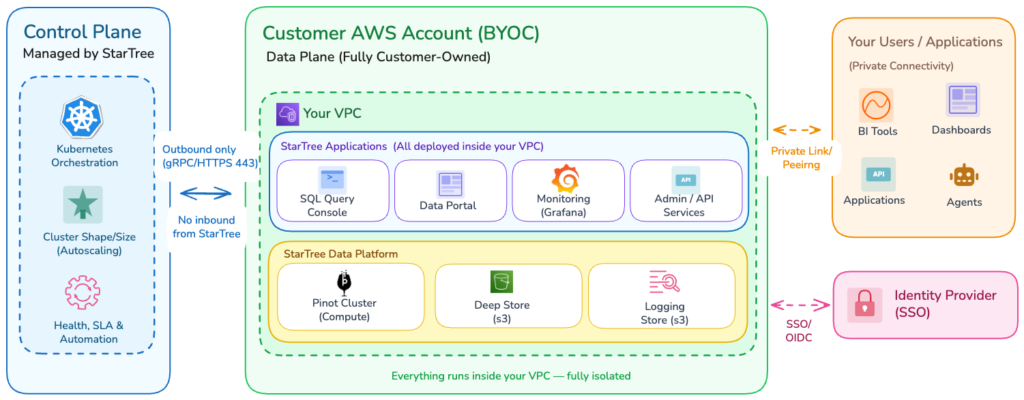
These customers’ data planes run inside their cloud environment. The tools used for data onboarding, management, and operations run there as well. Customer data stays within the customer data plane for routine use, while StarTree continues to provide the managed experience enterprises expect.
That balance is the core of StarTree’s approach: enterprise control over cloud, data, and security boundaries without turning real-time analytics into another self-managed platform. Today
BYOC should mean more than “deployed in your account”
Enterprises usually evaluate BYOC because they have strict requirements around security, compliance, data residency, networking, cloud standards, or operational governance. Those requirements are not satisfied by infrastructure placement alone.
A platform can run in a customer VPC and still create concerns around data movement, vendor access, external dependencies, and operational responsibility. It can also create a different experience from the vendor’s SaaS product, with gaps in features, tooling, support, or service expectations.
This is where the details matter.
Some BYOC models primarily answer the question, “Where does the software run?” StarTree BYOC is designed to answer a broader set of enterprise architecture questions: Where is the trust boundary? How is access governed? What depends on the control plane? Which tools run locally? Who owns upgrades and maintenance? Can the deployment evolve as requirements change?
StarTree has been architected with BYOC as a first-class deployment model, not a separate path for customers with stricter requirements. That foundation helps enterprises align StarTree with their security posture while preserving the consistency and managed operations of StarTree Cloud.
Keep data and operational workflows inside the customer boundary
One of the first questions enterprise architecture and security teams ask is simple: where does the data go?
With StarTree BYOC, customer data stays inside the customer data plane. The operational tools needed to onboard data, manage datasets, maintain the deployment, and operate the environment run locally in that same boundary.
That matters because BYOC should not require teams to move sensitive data into a vendor control plane for routine workflows. Even when infrastructure runs in the customer’s cloud, external dependencies can still raise concerns around compliance, access, auditability, and data movement.
StarTree’s model is designed to avoid that pattern. Customers can keep routine operational workflows within their own trust boundary while still benefiting from StarTree’s managed service.
Avoid inbound connectivity into the customer VPC
Vendor access is another area where the fine print matters.
Most enterprises do not want a managed service to require open-ended inbound connectivity, persistent tunnels, or access patterns that are difficult to govern. They want connectivity and access to be customer-controlled, temporary where appropriate, and auditable.
StarTree BYOC is designed with no inbound connectivity to the customer VPC. Customers can align the deployment with their security model using private endpoints, customer-controlled whitelisting, identity-provider integration, local data-plane authentication, and role-based access controls.
Managed service does not have to mean broad network access. StarTree can operate the platform in a way that respects enterprise security controls.
Let the data plane continue serving workloads independently
Production systems should not be overly dependent on a vendor control plane being continuously reachable.
In StarTree BYOC, the data plane is designed to continue serving production workloads even if the control plane is temporarily unavailable. When connectivity is available, StarTree provides managed operations as expected. When connectivity is limited or unavailable, the serving path is not tightly coupled to that external dependency.
That separation is important for enterprises with strict network controls, resilience requirements, or disconnected operating models. It gives architecture and security teams confidence that StarTree can fit into the way they already run critical systems.
Preserve a managed-service experience
A common BYOC tradeoff is that customers gain more control but inherit more operational work.
That is not what most enterprise data teams want. They want stronger alignment with internal security, cloud, and governance standards, but they do not necessarily want to operate another distributed analytics platform themselves.
StarTree BYOC preserves the managed-service experience. Customers keep control over cloud boundaries, networking, identity, security posture, and cost management. StarTree manages the platform lifecycle, including upgrades, scaling, maintenance, and routine operational work.
BYOC should not mean “you run it now.” It should mean the platform runs where and how the enterprise needs it to run, while the vendor continues to operate the service.
Fit into real enterprise cloud environments
Enterprise cloud environments are rarely generic. Teams already have standards for compute, storage, networking, observability, identity, access control, maintenance windows, cost management, and security tooling.
A useful BYOC model needs to fit into that environment. It cannot assume every customer operates the same way.
StarTree BYOC gives customers room to align deployments with their internal standards, including infrastructure choices, networking patterns, observability controls, maintenance windows, token management, and security settings.
The point is not just to deploy into the customer’s cloud. The point is to make the deployment feel like it belongs there.
Support deployment flexibility without product fragmentation
Enterprise deployment needs can change.
A team might start with SaaS, move to BYOC for tighter cloud control, adopt BYOK for deeper Kubernetes ownership, or require disconnected deployment patterns for specific environments. Those shifts should not force customers onto a different product experience.
StarTree supports SaaS, BYOC, BYOK, and disconnected variants from a common platform foundation. That helps customers avoid the fragmentation that can happen when deployment models are treated as separate product tracks.
For architects, deployment choice becomes a way to meet changing requirements, not a decision that boxes the team in later.
Make better use of existing cloud commitments
Security and control are usually the main reasons enterprises evaluate BYOC. But economics matter too.
Because StarTree BYOC runs in the customer’s cloud environment, customers can use existing cloud provider relationships, committed spend, reserved capacity, and internal cost-management practices.
That gives finance and platform teams more visibility and control over infrastructure spend, while keeping the operational model closer to a managed service than a self-managed deployment.
Questions to ask when evaluating BYOC
When comparing BYOC options, it is worth looking past the headline claim and asking practical architecture and operating questions:
- Does customer data need to leave the data plane for onboarding, management, troubleshooting, or routine operations?
- Does the vendor require inbound connectivity, persistent access, VPN tunnels, or SSH-based access patterns?
- Can the data plane continue serving production workloads if the control plane is unavailable?
- Do operational tools run inside the customer boundary, or do key workflows depend on the vendor control plane?
- Are the same features, tools, and operational processes available across deployment models?
- Who owns upgrades, scaling, maintenance, observability, and incident response?
- Can the deployment fit existing standards for networking, identity, compute, storage, security, and cost management?
- Can the organization move across SaaS, BYOC, BYOK, or disconnected models without replatforming?
These are the kinds of questions StarTree BYOC is designed to answer.
The StarTree difference
StarTree BYOC gives enterprises a way to run real-time analytics inside their own cloud boundaries without giving up the managed experience of StarTree Cloud.
Customer data and routine operational workflows stay in the customer data plane. The deployment is designed with no inbound connectivity to the customer VPC. The data plane can continue serving production workloads even when the control plane is temporarily unreachable. Customers retain control over networking, identity, security posture, and cloud economics, while StarTree manages upgrades, scaling, maintenance, and day-to-day operations.
For enterprises with strict security and operational requirements, BYOC should not be just another deployment checkbox. It should be an architecture that respects customer trust boundaries, supports existing cloud standards, and preserves the operational simplicity teams expect from a managed service.
That is what StarTree BYOC is built to deliver: enterprise control without self-managed complexity.